How to take your dog across the Atlantic on Queen Mary 2: kennels, costs and paperwork
Queen Mary 2 has 24 kennels and a $2,500 fee. Here is how to book one, the rules for each direction and what life is like for pets on board.
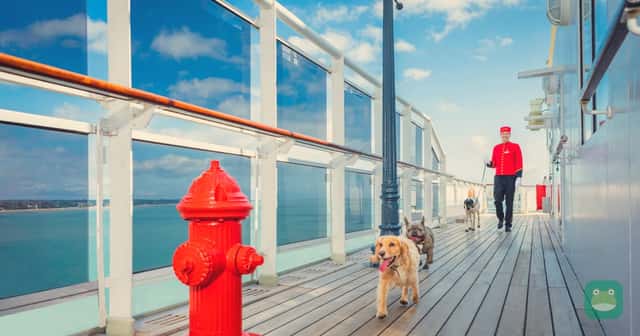
Queen Mary 2 is the only way to cross the Atlantic by sea with your dog on a regular schedule. Cunard keeps 24 kennels on Deck 12 for dogs and cats on its crossings between New York, Southampton and Hamburg. A kennel costs $2,500 per voyage for bookings made since May 18, 2026. Space sells out early. The paperwork depends on which way you sail, and it must be right before your dog can board.
This guide covers how to book, what it costs, the rules in each direction and what life in the kennels is like. It is built on Cunard's kennels page, its Queen Mary 2 FAQs, its kennel booking terms, and official U.S. and UK pet travel rules. For the rest of the crossing, from gala nights to the planetarium, see our Queen Mary 2 crossing guide. For ship details, see our Queen Mary 2 page and our Cunard page.
Rules change. Treat this as a starting point, and confirm every step with Cunard, your vet and the government sites linked below before you sail.
Which crossings take pets#
Kennels are offered on transatlantic crossings to or from Southampton, New York or Hamburg, Cunard says. Only cats and dogs can sail. A Cunard spokesperson told Forbes that Queen Mary 2 is "the only passenger ship operating regularly scheduled transatlantic voyages that allow pets to travel alongside their owners."
There are 24 kennels in total, according to Cunard. Pets stay in the kennels and their own deck area for the whole trip. Only assistance dogs, such as seeing-eye dogs, may go elsewhere on the ship.
Size limits and kennel types#
Forbes reports two kennel types. Upper kennels are for pets of 25 pounds or less. Lower kennels are for heavier pets. A pet can be up to 34 inches long and 27 inches tall. A longer pet, up to 59 inches, can use two adjoining kennels, and you pay for both.
| Kennel | Who it suits | Note |
|---|---|---|
| Upper | Pets of 25 lb or less | One kennel fee |
| Lower | Pets over 25 lb | One kennel fee |
| Two adjoining | Pets up to 59 in long | Two kennel fees |
Source: Forbes, Aug. 2026. Cunard confirms sizes when you book.
There is one more limit if you are heading to Britain. The UK bans five types of dog: the Pit Bull Terrier, Japanese Tosa, Dogo Argentino, Fila Brasileiro and XL Bully, per GOV.UK. A banned type cannot be brought into Great Britain unless it already has a valid Certificate of Exemption, the UK government says.
What it costs#
Cunard's kennel booking terms apply to bookings made on or after May 18, 2026. They set a fee of $2,500 per kennel, per voyage. That fee applies no matter how long the voyage is. It is charged on top of your own fare.
You pay a non-refundable $250 deposit when you book. The rest is due on the same date as the balance of your fare, usually 120 days before departure. If you miss that date, Cunard may cancel the kennel and keep the deposit.
| Days before departure | Kennel cancellation charge |
|---|---|
| 120 or more | $250 |
| 119 to 90 | $625 |
| 89 to 60 | $1,250 |
| 59 to 30 | $1,875 |
| 29 or fewer | $2,500 (no refund) |
Source: Cunard kennel booking terms, May 2026.
Older bookings may carry older prices. In August 2026, Forbes reported $1,300 for an upper kennel and $1,500 for a lower one. Cunard can change its terms, so confirm the price for your sailing in writing when you book.
How to book, and why to book early#
You need a Queen Mary 2 crossing booking first. Cunard says kennel reservations "can only be made with an eligible guest booking." To ask about space, or to book once you have your voyage, call Cunard's Customer Service Department or email kennels@cunard.com. In the U.S., the booking terms list (800) 728-6273.
Move fast. Kennels nearly sell out on every crossing, Cunard told Forbes. They are booked up to a year ahead, and there is often a waiting list. A good order of steps:
- Pick a crossingone that sails to or from New York, Southampton or Hamburg
- Check kennel spacecall Cunard or email kennels@cunard.com
- Book your voyagea kennel needs an eligible guest booking
- Book the kennelpay the $250 deposit
- Pay the balancewith your fare, usually 120 days before you sail
- Prepare the paperworkfollow the rules for the country you arrive in
Source: Cunard, Cunard booking terms
Westbound: Southampton to New York#
For the U.S., the rules come from the Centers for Disease Control and Prevention. Since August 1, 2024, dogs that have spent the past six months only in rabies-free or low-risk countries need just one document: the CDC Dog Import Form. The UK and Germany are not on CDC's high-risk list.
| Requirement | Detail |
|---|---|
| CDC Dog Import Form | Free, one per dog, done online |
| Age | At least 6 months old on arrival |
| Microchip | Must read on a universal scanner |
| Health | Dog must look healthy on arrival |
Source: CDC.
The form's receipt arrives by email. You can print it or show it on your phone to U.S. customs officials. It is valid for six months. CDC suggests filling it in a few days before travel, or up to six months ahead. Dogs that meet these rules can enter at any seaport.
CDC does not require a rabies shot for these dogs, but it "strongly recommends" one. If your dog has been in a high-risk country in the past six months, stricter rules apply. Use CDC's Dog Importation Navigator to check. CDC also notes that you must meet U.S. Department of Agriculture rules and the rules of your U.S. destination. These CDC rules cover dogs only. If you are bringing a cat, ask Cunard what it needs.
Eastbound: New York to Southampton#
Going to Britain takes more work and more careful timing. The UK government's rules set the steps, and they must happen in the right order:
- Microchip first. Your pet must be chipped before, or at the same time as, its rabies shot. If not, it must be vaccinated again.
- Rabies vaccine. Your vet needs proof your pet is at least 12 weeks old. You must then wait at least 21 full days after the first vaccination before you travel.
- Health certificate. The U.S. is a "listed" country, so your pet needs a Great Britain pet health certificate. No rabies blood test is needed from a listed country.
- Tapeworm treatment for dogs. A vet must treat your dog with praziquantel or an equivalent. It must be given no less than 24 hours and no more than 5 days (120 hours) before you arrive in Great Britain, and recorded on the certificate.
- Owner declaration. You sign a declaration that you are not going to sell or transfer your pet.
In the U.S., the health certificate is completed by a USDA-accredited vet and then endorsed by the USDA's Animal and Plant Health Inspection Service (APHIS). APHIS must ink-sign and emboss it, the agency says. For a non-commercial trip, the endorsement must happen within 10 days of your pet's arrival in the UK. For pets going by sea, APHIS says that 10 days is extended by the length of the sea voyage. Stricter UK rules apply if a pet arrives more than five days before or after its owner, which is not an issue when you sail together.
A timing question to settle early. The tapeworm window is 24 to 120 hours before arrival. A crossing takes seven nights, and Cunard says "there are no veterinary services on board Queen Mary 2." Ask Cunard's kennel team exactly when and where your dog's treatment must be given for your sailing, and get the answer in writing. Your vet and APHIS office should see it too.
The stakes are high. If you do not follow the rules, your pet may be put into quarantine for up to four months, or refused entry if you came by sea, the UK government warns. You pay any fees.
Sailing to or from Hamburg? EU rules apply there, and they differ from the UK's. Check them with Cunard and German officials.
Life in the kennels#
The kennels are run by the Kennel Master. You can walk and feed your pet yourself, or leave both jobs to the Kennel Master, Cunard says.
Next to the kennels is a deck area where pets can stretch their legs. It has a New York fire hydrant and a Liverpool lamp post, so pets have a familiar place to relieve themselves. Cunard's Pets on board story says the lamp post was taken from the Cunard Building in Liverpool. Cunard also lists a dedicated owners' lounge.
The kennels open several times a day. Cunard confirms exact times on board, but gives these as a typical schedule:
| Session | Usual hours |
|---|---|
| Morning | 8 a.m. to 10 a.m. |
| Late morning | 11 a.m. to noon |
| Afternoon | 3 p.m. to 6 p.m. |
| Evening | 8 p.m. to 8:30 p.m. |
Source: Cunard FAQs. Hours can change. Only guests sailing with a pet may enter.
Owners cannot take pets back to their cabins, Forbes reports. Each pet gets its own lifejacket when it boards. If the emergency alarm sounds, you can collect your pet and take it with you to your muster station.
What's included#
Cunard lists these extras for every kennel guest:
- Comfort: air conditioning and a fleecy blanket.
- A souvenir: a fitted coat to take home.
- A photo shoot: a free portrait with the ship's photographer and the Kennel Master, who dresses in Cunard's red bellhop uniform. Props include a Queen Mary 2 life ring, a Cunard jacket and a tiny bellhop hat.
- A welcome: a personal escort onto the ship.
- Food: Cunard contacts you before you sail with a choice of pet food brands it can offer. You can also bring your own. Freshly cooked chicken, vegetables and broth are available on request.
Forbes adds that pets get scheduled exercise and outdoor deck time each day.
What to pack#
These are practical suggestions, based on the rules above:
- Every original document. Your health certificate needs APHIS's ink signature and seal for Britain, so carry the paper original.
- Your CDC receipt, printed or on your phone, for New York.
- Your pet's usual food, if it has a sensitive stomach or a preferred brand.
- Any medicine your pet takes, with clear instructions. There is no vet on board.
- A leash and a familiar item, such as a blanket or toy from home.
Embarkation and arrival#
On embarkation day, Cunard reviews your documents and scans your pet's microchip in a dedicated check-in area, Forbes reports. The Kennel Master then escorts your pet on board.
In Southampton, your pet's microchip and documents will be checked, the UK government says. Pets traveling by sea may be checked before they board. Cunard told Forbes that once the paperwork is in order, pets do not need to go into quarantine when they arrive in Southampton or Hamburg.
In New York, have your CDC Dog Import Form receipt ready for U.S. customs officials.
If you plan to fly home with your pet later, the airline's rules are your responsibility, Cunard told Forbes.
Bigger kennels after the 2027 refit#
Queen Mary 2 goes into drydock in Brest, France, on March 31, 2027, and returns on May 9, 2027, Cunard said. The kennels are part of the work. Cunard promises redesigned kennels with more capacity, a refurbished owners' lounge and a bigger outdoor walking area. Its refit page calls the new owners' lounge "stylish." Cunard has not said how many kennels there will be after the refit.
There are no sailings while the ship is in drydock, so plan around those dates.
Tips before you go#
- Book the kennel the day you book the cruise. With 24 spaces, one popular sailing can fill.
- Get the price and size in writing. Cunard's current terms date from May 2026.
- See your vet early. The microchip, rabies shot and 21-day wait must come in the right order.
- Settle the tapeworm timing with Cunard before you book flights or hotels around the eastbound crossing.
- Check your dog is fit for a week at sea. There is no vet on board.
- Keep copies of everything, on paper and on your phone.
The rest of your week on board is covered in our crossing guide. For the ship's history, see Queen Mary 2 at 22.
More onQueen Mary 2Cunard
Cite this article
Patrick Karsh. “How to take your dog across the Atlantic on Queen Mary 2: kennels, costs and paperwork.” Cruises Frog. Published 2026-11-11. https://www.cruisesfrog.com/news/queen-mary-2-dog-kennels-guide-transatlantic-pet-travel
Wikipedia citation
{{cite news |title=How to take your dog across the Atlantic on Queen Mary 2: kennels, costs and paperwork |url=https://www.cruisesfrog.com/news/queen-mary-2-dog-kennels-guide-transatlantic-pet-travel |work=Cruises Frog |author=Patrick Karsh |date=2026-11-11 |language=en}}CSL-JSON for reference managers
{
  "id": "https://www.cruisesfrog.com/news/queen-mary-2-dog-kennels-guide-transatlantic-pet-travel",
  "type": "article-newspaper",
  "title": "How to take your dog across the Atlantic on Queen Mary 2: kennels, costs and paperwork",
  "URL": "https://www.cruisesfrog.com/news/queen-mary-2-dog-kennels-guide-transatlantic-pet-travel",
  "container-title": "Cruises Frog",
  "language": "en",
  "author": [
    {
      "literal": "Patrick Karsh"
    }
  ],
  "issued": {
    "date-parts": [
      [
        2026,
        11,
        11
      ]
    ]
  }
}Citations identify this article and its publication date. Assess the reporting and its linked sources before using it as evidence.
Read this article as Markdown or JSON. Cite the original page and retain its sources, dates and qualifications.
Embed this article summary
Paste this HTML into your page. The summary stays linked to the full story and updates with it. No account required.
<iframe src="https://www.cruisesfrog.com/embed/news/queen-mary-2-dog-kennels-guide-transatlantic-pet-travel?theme=auto" title="How to take your dog across the Atlantic on Queen Mary 2: kennels, costs and paperwork by Cruises Frog" width="100%" height="440" style="border:0;max-width:100%" loading="lazy"></iframe>
<p style="font-size:14px">How to take your dog across the Atlantic on Queen Mary 2: kennels, costs and paperwork by <a href="https://www.cruisesfrog.com/news/queen-mary-2-dog-kennels-guide-transatlantic-pet-travel" rel="nofollow">Cruises Frog</a></p>
<script async src="https://www.cruisesfrog.com/embed.js"></script>